
poe vs ip camera
PoE vs IP Camera: Key Differences for UK Buyers (2026)
PoE and IP aren't rivals: "IP" describes how a camera sends digital video over a network, while "PoE" describes how it's powered, so every PoE camera is an IP…
On this page
- How to choose poe vs ip camera
- 5MP AI IP Dome Camera LWA28PW-C3 PoE ONVIF IP67 — best for mixed-brand recorders
- Smart Hybrid Light PoE Camera, 4MP Turret with Two-Way Audio: best for wired sites that need to talk back
- Hikvision 8MP ColorVu PoE Turret Camera, 2-Way Audio: best for colour at night
- Hikvision 8MP Motorized Varifocal PoE Turret Camera, best for framing the shot after it's mounted
- Which one should you buy?
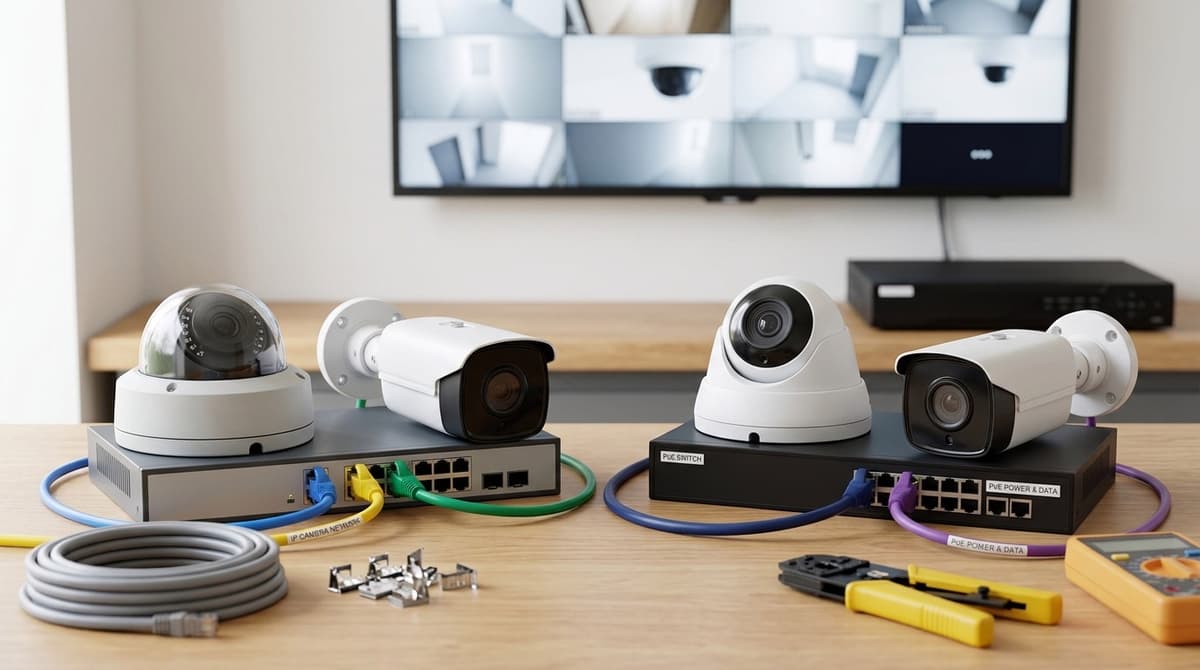
PoE and IP aren't rivals: "IP" describes how a camera sends digital video over a network, while "PoE" describes how it's powered, so every PoE camera is an IP camera but not every IP camera uses PoE. The real choice is between a PoE IP camera (power and data over one Ethernet cable, typically to an NVR or PoE switch), an IP camera with a separate power supply, and a Wi-Fi IP camera. PoE suits most new wired CCTV installs, but the right pick depends on your cable runs, your switch or recorder's PoE budget, and the 100m Ethernet limit, so check each camera's datasheet and the installation guide before you buy.
How to choose poe vs ip camera
Choose PoE if you can run Ethernet to each camera; choose a non-PoE IP camera only where cabling is impractical. A PoE camera is still an IP camera, as CCTV Security Pros puts it, so the real decision is how the camera is powered and recorded.
-
Cable route. PoE carries power and data over one Cat5e or Cat6 run. A Wi-Fi IP camera still needs a power supply at the camera, and a socket within reach, so check each position before you commit.
-
Power budget. Add up the rated draw of every camera on the datasheets and compare it with the switch's total PoE budget, not just its port count. Leave headroom, and confirm the camera's PoE standard matches the switch, such as IEEE 802.3af.
-
Recorder compatibility. PoE cameras need a PoE switch or NVR port. If you plan to mix brands, look for ONVIF support, as on the 5MP AI IP Dome Camera LWA28PW-C3, which lists Profile S/G/T/M and a micro SD slot for local backup.
-
Existing coax. Moving from a BNC system to PoE normally means new network cable. If the coax is sound, HD-over-coax may cost less. If you want IP features, such as two-way audio or remote lens adjustment, budget for the cabling.
5MP AI IP Dome Camera LWA28PW-C3 PoE ONVIF IP67 — best for mixed-brand recorders
If you want one cable per camera and the freedom to use a recorder of your choice, this 5MP dome is the one to look at, because it is PoE-powered and supports ONVIF Profile S/G/T/M.
- Picture and night vision: 5MP resolution with 30m IR.
- AI: Face detection built in.
- Storage: A micro SD slot for 256GB, so footage can be kept on the camera if the network or recorder drops out.
- Weather rating: IP67 appears in the model name, which suits outdoor mounting as well as a PoE IP camera indoors.
As the CCTV Security Pros guide puts it, a PoE camera is an IP camera that takes power and data over Ethernet. You'll therefore need a PoE switch or PoE recorder port, and it's not for anyone wanting a wireless camera. Face detection also brings extra data-protection questions, so check the ICO's CCTV guidance before switching it on. The 5MP AI IP Dome Camera LWA28PW-C3 is the model to compare against your current recorder's ONVIF support.
Smart Hybrid Light PoE Camera, 4MP Turret with Two-Way Audio: best for wired sites that need to talk back
For a property with Ethernet cabling that wants to challenge visitors as well as record them, the Smart Hybrid Light PoE Camera, 4MP Turret with Two-Way Audio (Hikvision DS-2CD1343G2-LIUF/SL) is a sensible fit.
- Image: 4MP resolution in a turret body with a 98° view.
- Night: IR and white light reaching 30m, so you can choose between monochrome infrared and a lit scene.
- Audio: two-way audio for speaking to someone at the camera.
- Connection: a PoE camera is an IP camera that takes power and data over Ethernet, as CCTV Security Pros puts it. Here that means one cable to a PoE switch or an NVR port.
It has no Wi-Fi route, so if you can't run cable, or you want a plug-in camera, look at a different type. Check the datasheet for PoE budget and the 98° coverage before you plan the layout.
Hikvision 8MP ColorVu PoE Turret Camera, 2-Way Audio: best for colour at night
This is an 8MP PoE turret for buyers who want full-colour night images and the ability to talk through the camera, such as a shopfront, yard or driveway.
- Night image: ColorVu full-colour night images with a 30m hybrid light.
- Audio: two-way audio, so you can speak to someone at the camera as well as hear them.
- Power and data: PoE, so a single network cable carries both, as PoE is generally defined. No separate power supply is needed at the camera.
- Recording: works with ONVIF recorders, so you aren't tied to one recorder brand.
It needs a PoE switch or an NVR with PoE ports, so anyone starting from scratch should budget for one of those. It also isn't for Wi-Fi-only setups, because it relies on a cabled run. If that suits your site, the Hikvision 8MP ColorVu PoE Turret Camera, 2-Way Audio is a sensible all-rounder. Have your own electrician or installer fit it, and check the datasheet or installation guide for mounting and cable details.
Hikvision 8MP Motorized Varifocal PoE Turret Camera, best for framing the shot after it's mounted
If you can't be sure of the right field of view until the camera is on the wall, this 8MP PoE turret is the one to pick, because its 2.8-12mm motorized lens lets you adjust zoom and focus remotely rather than from a ladder.
- Lens: the motorized varifocal 2.8-12mm lens covers a wide scene or a tighter view of a gate or doorway without swapping hardware.
- Resolution: 8MP gives more detail to work with when you review footage.
- Night and weather: 30m night vision and an IP67 housing suit an exposed outdoor position.
- Power: it is a PoE camera, so one network cable carries both power and data.
It needs a PoE switch or a recorder with PoE ports, so it's a poor fit if you want to plug into a mains socket or rely on Wi-Fi. For a fixed spot where the view is already known, a simpler fixed-lens camera will do the same job with less to set up. You can see the full details on the Hikvision 8MP Motorized Varifocal PoE Turret Camera page.
Which one should you buy?
For most buyers building a new wired system, a PoE IP camera is the right choice. Wi-Fi earns its place only where a cable genuinely can't be run.
Which PoE model suits you depends on the job:
- Budget: the Smart Hybrid Light PoE Camera, 4MP Turret with Two-Way Audio suits a single entrance or yard. It is the lowest resolution of the PoE cameras we list, with IR and white light to 30m and a 98° view. Check the live price on its page.
- Best overall: the 5MP AI IP Dome Camera LWA28PW-C3 is the safest all-rounder. It has 30m IR, IP67 protection, a 256GB micro SD slot and ONVIF Profile S/G/T/M, so it should work with most ONVIF recorders. That makes it a sensible indoor or outdoor choice for a home or small business.
- Specific use-case: the Hikvision 8MP Motorized Varifocal PoE Turret Camera fits positions where you can't judge the framing until it's live. Its 2.8–12mm lens adjusts zoom and focus remotely, which saves a second trip up the ladder.
Each of these needs a PoE switch or an NVR PoE port, and your own electrician or installer will need to fit it, so check the datasheet first. You can browse the range or ask for a suggested system if you'd rather have the pairing worked out for you.
Recommended products
From our own range — picked for what this guide covers.
- 5MP AI IP Dome Camera LWA28PW-C3 PoE ONVIF IP675MP AI dome camera with face detection, 30m IR, PoE power, 256GB micro SD slot and ONVIF Profile S/G/T/M. Prices include VAT. Free UK delivery over £100.View product →
- Smart Hybrid Light PoE Camera, 4MP Turret with Two-Way AudioSmart hybrid light PoE camera: 4MP turret with IR and white light to 30m, 98° view and two-way audio. Needs a PoE switch or NVR port. Hikvision DS-2CD1343G2-LIUF/SL.View product →
- Hikvision 8MP ColorVu PoE Turret Camera, 2-Way Audio8MP ColorVu PoE turret camera with full-colour night images, 30m hybrid light and two-way audio. Needs a PoE switch or NVR; works with ONVIF recorders.View product →
- Hikvision 8MP Motorized Varifocal PoE Turret Camera8MP motorized varifocal PoE turret camera: 2.8–12mm lens adjusts zoom and focus remotely. 30m night vision, IP67 housing. Needs a PoE switch or recorder.View product →
Frequently asked questions
What is the difference between poe camera and ip camera?
"IP" describes how a camera sends digital video over a network. "PoE" describes how it is powered: power and data share one Ethernet cable. Every PoE camera is an IP camera, but not every IP camera is PoE, because some use a separate power supply or Wi-Fi.
Are poe cameras better?
They are better for some jobs, not all. For new builds with an NVR or PoE switch, one Cat5e or Cat6 cable carries power and data, which simplifies installation. A separate-PSU or Wi-Fi IP camera may suit an existing site better. Check each datasheet and your switch's power budget.
What is poe ip security camera?
It is a network security camera powered through its Ethernet cable, typically to IEEE 802.3af. The Smart Hybrid Light PoE Camera, 4MP Turret with Two-Way Audio needs a PoE switch or NVR port, so confirm one is free.
Can a PoE camera run without a PoE switch?
Only if the model allows it. Some PoE cameras also have a secondary 12V DC input for sites where PoE isn't used. Cameras like the 5MP AI IP Dome Camera LWA28PW-C3 are PoE-powered, so check the datasheet for alternatives.
How to open ip camera in browser?
Steps vary by model, so follow the installation guide. Generally, you find the camera's IP address on your network, enter it in your browser's address bar, then log in with the credentials the guide gives. Your installer can set this up and confirm access.
Sources & references
- poe
- vs
- ip
- camera
Written by
Clear Security Editorial Team
Buying guides researched against the equipment we stock, with every specification checked back to the manufacturer's datasheet and UK guidance reviewed before publication.
Related reading
- HD Over Coax Camera Systems: UK Guide for 2026hd over coax camera
- CCTV Lens Size for Face Recognition at 10 Metres (2026)what lens size cctv camera do i need to see a face at 10 metres
- 4MP vs 8MP CCTV Cameras: What the Difference Means in 2026what does 4mp vs 8mp mean for cctv cameras
- CCTV Camera Cost for a Shop UK 2026: Full Guidecctv camera cost for shop
- What Is a Camera Bracket? UK CCTV Guide 2026what is a camera bracket?
- ANPR Camera Cost UK 2026: Hardware, Install and Systemsanpr camera cost uk