
what is a camera bracket?
What Is a Camera Bracket? UK CCTV Guide 2026
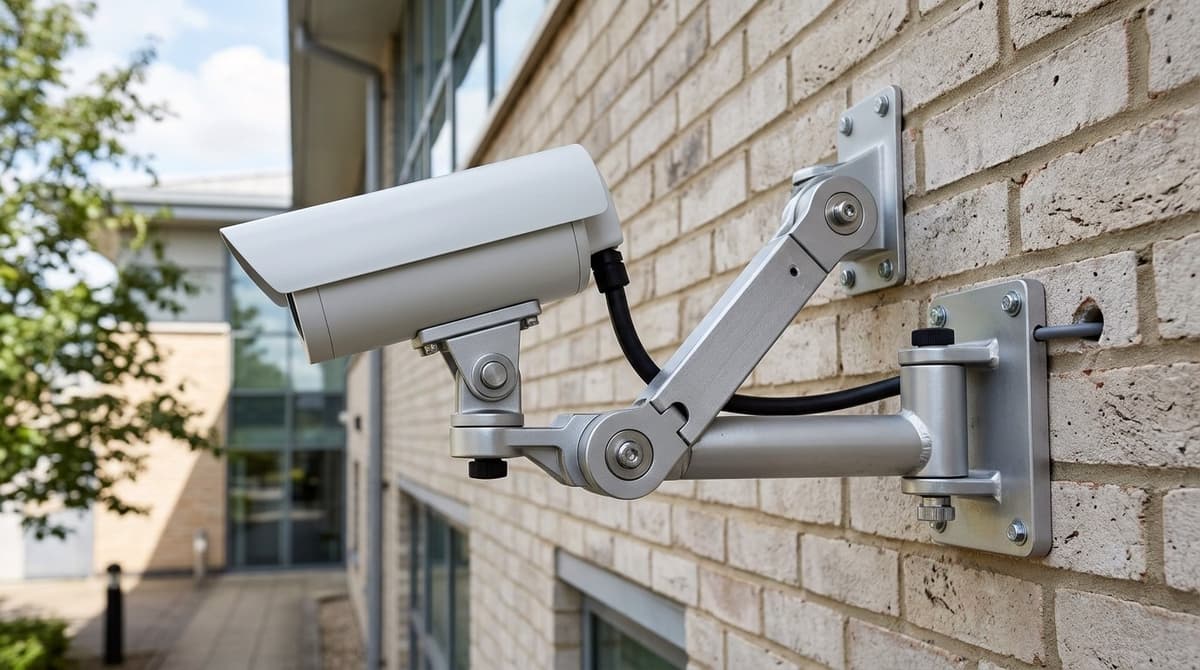
A camera bracket is the arm or plate that fixes a CCTV camera to a wall, soffit, pole or corner and holds its aim steady.
On this page
- What is a camera bracket, and how does it differ from a mount or junction box?
- Which bracket suits a bullet, dome or PTZ camera?
- Bullet cameras
- Dome cameras
- PTZ cameras
- The decision rule
- Which bracket works on brick, render, soffit, pole or corner?
- What do IP66, wind and vibration ratings mean for a bracket?
- Load and wind
- Vibration
- Material and finish
- What should you check before fitting? A UK bracket checklist
- Match bracket to camera
- Cable routing and the junction box
- Fixing and safety
A camera bracket is the arm or plate that fixes a CCTV camera to a wall, soffit, pole or corner and holds its aim steady. It must suit the camera's base, the surface it is fixed to and the weather exposure, so a bracket that works on a sheltered brick wall may not be right for an exposed pole.
It is separate from the camera mount (the camera's own base or fixing interface) and the junction box (the enclosure that terminates the cable), though the three are usually specified together. The term also covers photography L-brackets, which are an unrelated product.
What is a camera bracket, and how does it differ from a mount or junction box?
A camera bracket is the hardware that fixes a camera to a wall, ceiling or pole and keeps it steady and aimed. It differs from the camera mount, which is the camera's own base, and from the junction box, which houses the cable terminations.
A camera bracket is the hardware that fixes a camera to a wall, ceiling or pole and keeps it steady and aimed where you set it. Security Camera King groups them by those surfaces. Corner and pole variants cover places where a flat wall isn't available.
Three terms get tangled:
- Bracket: the arm or plate that sits between the surface and the camera.
- Camera mount: the camera's own base or fixing interface, meaning the part of the camera that bolts onto a bracket. Photographers use "mount" for the lens fitting, such as a bayonet, which is a different thing entirely.
- Junction box: the enclosure where cable is terminated behind or under the camera, so the connections are protected rather than left dangling.
An "L bracket" is also not a CCTV fitting. It is a tripod plate that lets a stills camera switch between horizontal and vertical orientation, per Digital Camera World.
In practice, bracket and junction box work as a pair. The bracket carries the camera's weight and sets its angle, while the box houses the cable joins. Pole-mount adapters are typically designed to work with standard camera mounts and junction boxes, but check your camera's datasheet for its base fixing pattern and whether a box is supplied. Your own electrician or installer will fit the pair.
Which bracket suits a bullet, dome or PTZ camera?
Bullets usually take a wall or soffit arm bracket, domes fix direct to a ceiling or soffit, and a PTZ needs a bracket whose rated load covers its weight.
Bullet cameras
A bullet typically sits on a wall or soffit arm. You aim it at the camera's own ball joint, so the bracket's job is to hold position and carry the lens clear of the wall or eaves.
Dome cameras
A dome generally screws straight to a ceiling or soffit through its base plate. If it has to go on a wall, a wall adaptor plate gives it a suitable face to sit on.
PTZ cameras
A PTZ has a motorised head, so its mass moves and shifts the load on the bracket as it pans and tilts. Check the bracket's rated load against the camera's weight on the datasheet rather than judging by how sturdy the bracket looks.
The decision rule
- Take the camera's weight and its base-plate hole pattern from the datasheet.
- Pick a bracket, or adaptor plate, that carries that weight and lines up with that hole pattern.
Never choose by looks. A bracket that suits the camera's fixings and weight will do the job, however plain it appears.
Which bracket works on brick, render, soffit, pole or corner?
Match the bracket to what sits behind the surface: a wall or ceiling bracket for solid fixings, a pole adaptor for round poles, a corner bracket for two-aspect coverage, and adhesive only for light indoor cameras.
- Brick and block: A standard wall bracket with masonry plugs and screws suits solid brickwork. Where the wall is rendered, fix through the render into the masonry beneath, because render alone will crumble under the weight and leverage of a camera.
- Hollow or cavity walls: Use fixings made for the wall type, or move the camera to a solid section. A bracket that is secure on brick can pull out of plasterboard or thin cladding.
- Plastic soffits: The board is not a fixing point. Locate a solid timber or other structural member behind it and screw into that, using a ceiling-style or short wall bracket as the layout allows.
- Poles: A pole-mount adaptor wraps a round pole and replaces the wall or ceiling fixing. It is used where no wall is available, and many of these adaptors accept standard camera mounts and junction boxes.
- Corners: A corner-mount bracket places the camera on the angle of two walls, so it can cover both elevations. The metal versions are made for indoor and outdoor use.
- Stick-on: Adhesive mounts belong on lightweight indoor cameras, such as a home or baby-monitor camera. Leave them off anything heavy or outdoors.
Whoever fits the kit should check the camera's datasheet for its weight and cable routing before choosing a bracket.
What do IP66, wind and vibration ratings mean for a bracket?
IP66 means dust-tight and protected against powerful water jets under IEC 60529 / BS EN 60529, but it describes the camera or enclosure, not the bracket. A bracket has no IP rating to match. Its job outdoors is to resist corrosion and keep water from tracking down the cable into the fixing point or junction box. For a fuller explanation of IP67 and other ratings, see our guide.
Load and wind
Arm length acts as a lever: the longer the arm, the more leverage the camera's weight and wind push exert on the wall or pole fixings. Exposed poles and gable ends move more than a sheltered wall, so they deserve a shorter arm and sound fixings. I haven't quoted wind-speed figures because they vary by product.
Check the bracket datasheet for its load rating and the camera datasheet for its weight.
Vibration
Loose fixings and flexing arms blur footage and let the aim drift over time. Metal brackets generally hold their position better than thin plastic ones, particularly with a heavier camera on a long arm.
Locking hardware also helps. Lock nuts, spring washers or thread-lock stop screws backing off, and pole brackets are designed to resist movement or loosening in use.
Material and finish
Durable metal is the usual choice for outdoor brackets, and heavy-duty corner mounts are described as suitable for indoor and outdoor use. Check the product page for the stated material and finish, and use fixings that suit the surface, with the installation guide to hand for whoever is fitting it.
What should you check before fitting? A UK bracket checklist
Confirm the bracket suits the camera's hole pattern, thread and weight, then plan cable entry, junction box position and who will fit it.
Match bracket to camera
Compare the camera base with the bracket on both datasheets: hole spacing, screw thread and rated load. A camera that is heavier than the bracket's stated capacity is a fault waiting to happen, however well the holes line up.
C and CS are lens-mount standards, so they say nothing about whether a bracket will fit. The bracket interface is a separate matter.
Cable routing and the junction box
- Through-bracket routing: the cable runs hidden inside the arm. It looks tidier and is harder to tamper with, but you need a bracket with a hollow path.
- External routing: it is easier to fit, but the cable is exposed and easy to snag or cut.
Whichever you choose, leave a drip loop, a downward sag in the cable just before it enters, so water runs off rather than in. Seal the entry point as well.
Terminate and protect the connections in a junction box, mounted with the cable entries facing down. Many brackets are designed to work with standard junction boxes, but check the datasheet for your pairing.
Fixing and safety
Your own electrician or installer should fit the kit, working from the product's datasheet or installation guide. Clear Security sells equipment and does not carry out installations. Any mains-voltage connection is a job for a competent electrician, not a DIY afterthought.
Frequently asked questions
What is a camera bracket?
A camera bracket is the arm or plate that fixes a CCTV camera to a wall, ceiling, pole or corner and holds its aim. It must suit the camera's base, the surface and the weather exposure. It is often paired with a junction box, which houses the cable termination behind or beneath the camera.
What is a camera mount?
In CCTV, a camera mount usually means the camera's own base or fixing interface. The bracket is the separate arm or plate it attaches to. The terms are often used loosely, so check the product description. The mount fits the camera, while the bracket fits the surface, such as a wall, pole or corner.
What are camera L brackets for?
Camera L brackets are a photography product. These L-shaped plates attach to a stills or video camera so it can sit on a tripod head in portrait or landscape orientation. They are not CCTV hardware. For security cameras, you need a wall, ceiling, pole or corner bracket instead.
What is a camera C mount?
A C mount is a screw-thread lens fitting found on some CCTV and industrial cameras, which allows interchangeable lenses. It describes the lens connection, not how the camera is fixed to a surface. Many fixed-lens cameras don't use it, so check the datasheet before assuming a lens can be swapped.
What are the types of camera brackets?
Common CCTV types are wall or soffit arm, ceiling, pole and corner brackets. Pole brackets adapt a camera to a round pole rather than a flat wall. Corner brackets suit external corners and give wider coverage. Choose by surface, camera style and exposure, and use durable metal for outdoor installations.
Sources & references
- what
- is
- camera
- bracket
Written by
Clear Security Editorial Team
Buying guides researched against the equipment we stock, with every specification checked back to the manufacturer's datasheet and UK guidance reviewed before publication.
Related reading
- What Is a CCTV Camera Kit? 2026 Guidewhat is a camera kit?
- Best CCTV System 2026: How to Choose for UK Homes and Shopswhat cctv system is the best
- CCTV Lens Size for Face Recognition at 10 Metres (2026)what lens size cctv camera do i need to see a face at 10 metres
- What Is a CCTV Monitor? Display Types and Buying Guidewhat is a cctv monitor
- What Is an NVR Recorder: IP Camera Recordingwhat is a nvr recorder
- HD Over Coax Camera Systems: UK Guide for 2026hd over coax camera