
infrared vs colour night vision cctv which is better
Infrared vs Colour Night Vision CCTV: Which Is Better?
Neither is better everywhere: infrared (IR) night vision is the safer choice where the area is genuinely dark or where visible light would upset neighbours…
On this page
- Infrared or colour night vision: which is better for your site?
- Infrared: what you gain and lose
- Colour: what you gain and lose
- Lighting matters more than the label
- How do night vision CCTV cameras work?
- Infrared (IR)
- Colour (ColorVu-style)
- Hybrid dual-light
- Which night vision suits a farm yard, terraced house, shop front or car park?
- What happens at dusk and dawn, and why does IR bounce off close or wet surfaces?
- Dusk and dawn
- Why IR bounces
- Test before final fixing
- Will colour night lights upset the neighbours, and what does UK GDPR expect?
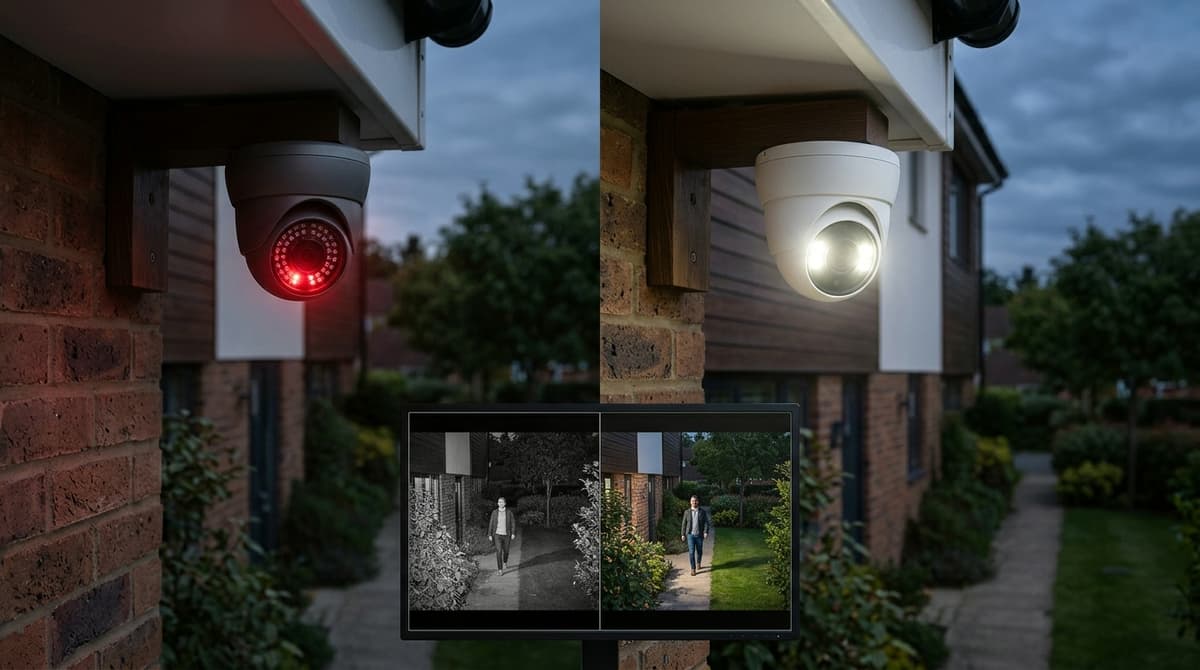
Neither is better everywhere: infrared (IR) night vision is the safer choice where the area is genuinely dark or where visible light would upset neighbours, while colour night vision wins where street or white light already exists and clothing or vehicle colour matters. IR works in total darkness but records in monochrome, whereas colour cameras need enough light and a short enough exposure to avoid blurring moving subjects. For mixed sites, a hybrid dual-light camera that switches between the two modes is often the practical compromise.
Infrared or colour night vision: which is better for your site?
Choose infrared where there is no ambient light, the target is distant or the site must stay dark. Choose colour where lighting already exists and clothing or vehicle colour matters.
Four inputs settle it:
- ambient light (street lighting or none)
- distance to the target
- whether visible light is acceptable on site
- whether you need identification (face, clothing, vehicle colour) or only detection of a person or vehicle
Detection at range in the dark points to infrared. Identification under existing light points to colour.
Infrared: what you gain and lose
- It works in complete darkness and adds no visible light, and it is usually the lower-cost option, according to SightShield.
- The image is black and white, so clothing and vehicle colours are lost.
- Reflective surfaces and nearby walls can glare. Insects and spider webs close to the lens get lit up and can trigger motion alerts.
Colour: what you gain and lose
- It keeps the clues that monochrome discards, such as clothing and vehicles. GVISION notes, however, that colour needs enough light and an exposure short enough for movement.
- A bright picture can still be useless if a walking person is blurred.
- Cameras that add their own white light solve the darkness problem but are no longer covert. One Hikvision ColorVu turret in our reference data quotes up to 20 m of white-light distance, so check that range against your distance to target.
Lighting matters more than the label
GVISION's view is that carefully targeted lighting and scene-specific calibration often make the greatest difference. A well-aimed, well-tuned camera of either type can beat a more expensive one left on default settings. Its first key point is to test in full darkness before you commit.
How do night vision CCTV cameras work?
Night vision CCTV either floods the scene with invisible infrared and records in monochrome, or gathers visible light to keep colour.
Infrared (IR)
At dusk the camera's IR LEDs switch on, commonly at 850nm or 940nm per CCTVPROS. The IR-cut filter (ICR), which blocks infrared by day so colours stay true, moves out of the light path. The sensor now records infrared, which carries no colour information, so the picture is black and white.
Colour (ColorVu-style)
Colour night vision adds no infrared glow. It collects more visible light with a large-aperture F1.0 lens, which admits far more light than the F2.0 lens on a standard camera, according to G-TEC. That lens is paired with a sensitive sensor and often a supplementary white-light LED.
As a spec illustration only, a 3K ColorVu PIR turret is listed at 2960 × 1665 with a 2.8mm lens and white light up to 20m.
Hybrid dual-light
Dual-light cameras run in IR by default and switch to colour or white light when triggered, as SightShield describes. What counts as a trigger, and how long the colour mode holds, differs by model, so check the datasheet before buying.
Which night vision suits a farm yard, terraced house, shop front or car park?
Ambient light decides: farm yards and unlit car parks lean infrared, while lit shop fronts and car parks suit colour. The table is installer guidance from typical site conditions, not measured test results.
| Site | Typical light | Lean towards | Watch-out |
|---|---|---|---|
| Rural farm yard | Little or none | IR, or a hybrid with targeted lighting | Insects and webs near the lens; rain |
| Terraced house with street light | Some ambient light | Colour at the front, IR at the back | Light-spill; neighbours' windows |
| Shop frontage | Shop and street light, plus glass | Colour | Reflections off glazing; backlight (WDR) |
| Car park | Depends on whether it is lit | Lit: colour. Unlit: IR with targeted lighting | Lighting that fails or doesn't cover the whole view |
On a farm, SightShield notes that insects and spider webs close to the lens get lit up by the IR LEDs and can trigger motion alerts. GVISION also lists rain among the IR nuisances. Mount cameras where webs can't bridge the lens, and see our farm CCTV article for the wider layout.
For shop fronts, colour keeps clothing and vehicle colours that monochrome loses, according to G-TEC. Glass adds reflections and strong backlight, so choose a camera with WDR and aim it off the glazing.
On a terrace, a white-light LED at the back can spill into neighbouring windows. That is why the rear usually gets IR.
What happens at dusk and dawn, and why does IR bounce off close or wet surfaces?
Dusk and dawn are when the camera changes mode, and close or wet surfaces reflect its own IR back, washing out the picture.
Dusk and dawn
As light falls, a standard IR camera drops to black-and-white and switches on its IR LEDs, as SightShield describes it. Colour-at-night designs such as ColorVu avoid that switch by using a larger aperture lens and a white-light LED, per G-TEC.
Frames captured mid-transition can look soft because the camera is changing mode. During commissioning, check the live image at dusk and again at dawn, not only at midday and midnight. Manufacturers' behaviour varies, so treat this as a general check.
Why IR bounces
Reflective surfaces and nearby walls can glare, and insects and spider webs near the lens get lit up and can trigger motion alerts, according to SightShield. GVISION also lists rain and insects among IR's weak points and puts "avoid nearby reflective surfaces" in its key points.
Practical fixes:
- Mount the camera clear of fascias, soffits and walls, so the IR beam doesn't return off them.
- Angle it away from wet paving, glossy cladding and other reflective surfaces.
- Clean the lens and housing, and clear any webs.
Test before final fixing
GVISION's advice is to test in full darkness. Your own electrician or an independent installer should carry out the fitting and these tests, following the product datasheet or installation guide. We sell the equipment and do not install it, so for fitting, use an NSI or SSAIB-accredited installer of your choosing.
If you're weighing IR against colour models, you can browse the range or ask for a suggested system.
Will colour night lights upset the neighbours, and what does UK GDPR expect?
White-light colour cameras can throw visible light onto a neighbour's property, while infrared adds none. Either type can still record whatever it is pointed at.
A ColorVu-style camera pairs an F1.0 lens with a supplemental white-light LED, as G-TEC explains. That LED is visible, so a beam across a bedroom window is a fair complaint. Mount it so the light falls on your own drive or doorway, and if the model has a strobe or siren, position it with the same care.
Infrared is invisible, but the lens still sees the same scene, so the privacy question is identical. Keep the field of view to what you need, and where the camera allows it, mask out neighbouring windows and gardens.
Whether UK GDPR applies depends on the setting. A purely domestic camera watching your own property is treated differently from business use, or from a camera that captures public space or a neighbour's land. Where the rules do apply, the ICO's CCTV guidance expects a clear purpose and visible signage. Our UK GDPR guides cover the detail, so check them before you mount anything.
For fitting, use an independent installer accredited by NSI or SSAIB. Browse the range at clearsecurity.co.uk or ask for a suggested system that suits your site.
Frequently asked questions
Infrared vs colour night vision CCTV: which is better?
Neither is better everywhere. Choose infrared where the area is dark or visible light is unwelcome. Choose colour where street or white light exists and clothing or vehicle colour matters. Hybrid dual-light cameras suit mixed sites, so match the camera to the lighting, distance and identification need.
How do night vision CCTV cameras work?
Infrared cameras use built-in IR LEDs, commonly 850nm or 940nm, to light the scene with illumination people can't see. The image is recorded in monochrome. Colour-style cameras instead depend on ambient or built-in white light. Real range varies by model, so check the datasheet.
How does colour night vision work?
Colour night vision keeps the picture in colour after dark by using enough visible light, either street lighting or a camera's built-in white light, rather than switching to monochrome IR. It also needs an exposure short enough to avoid blur on moving people or vehicles. Some white-light models quote about 20 m.
What is the best CCTV for night vision?
There's no single best. IR suits dark yards and longer distances, and some IR cameras list 50 m. Colour suits lit areas where identifying clothing or vehicle colour matters. Targeted lighting and proper scene calibration often matter more than the camera's night-vision label.
Which is better if neighbours might object to light?
Infrared is the safer choice because it adds no visible light. Colour cameras that use white light illuminate the scene, which can bother neighbours. If you choose one, check how it is aimed and what triggers it.
Sources & references
- Colour Night Vision vs Infrared CCTV: Which Is Better? | G-TEC
- ColorVu vs IR Night Vision Cameras | IDS CCTV | IDS CCTV Blog | IDS CCTV
- Night Vision CCTV: Infrared or Full Colour?
- Colour Night Vision vs Infrared CCTV Camera: Which Is Better?
- CCTV Night Vision Guide 2024 — IR vs ColorVu vs Starlight Cameras | CCTVPROS Kottayam
- Night Vision vs Infrared - What Is the Difference?
- infrared
- vs
- colour
- night
- vision
- cctv
- which
- is
- better
Written by
Clear Security Editorial Team
Buying guides researched against the equipment we stock, with every specification checked back to the manufacturer's datasheet and UK guidance reviewed before publication.
Related reading
- Best CCTV System 2026: How to Choose for UK Homes and Shopswhat cctv system is the best
- 4MP vs 8MP CCTV Cameras: What the Difference Means in 2026what does 4mp vs 8mp mean for cctv cameras
- What Is a CCTV Monitor? Display Types and Buying Guidewhat is a cctv monitor
- Home CCTV Systems UK 2026: Wired or Wireless?home cctv systems uk
- CCTV Christmas Shopping Season 2026: UK Readiness Guidecctv during christmas shopping season uk
- CCTV Lens Size for Face Recognition at 10 Metres (2026)what lens size cctv camera do i need to see a face at 10 metres