
anpr camera meaning
ANPR Camera Meaning: What ANPR Stands For
ANPR stands for Automatic Number Plate Recognition.
On this page
- What does ANPR stand for, and what does it mean in a camera?
- How does ANPR work, step by step?
- Why isn't an ANPR camera a plug-in upgrade to a normal IP camera?
- What the install has to get right
- ANPR glossary: read rate, capture zone, OCR, LPR vs ANPR
- What should you check before choosing an ANPR camera?
ANPR stands for Automatic Number Plate Recognition. An ANPR camera captures an image of a vehicle's number plate, and software reads the characters off it as text. Ordinary CCTV records a scene for a person to watch back, whereas ANPR produces data (plate, time, location) that other software can store, search, check against a list or use to trigger something such as a barrier. Reading the plate is the core of it; what happens to the text afterwards depends on who runs the system. Getting a reliable read is a specialist job, because it depends on exposure, lighting and angle as well as the recognition software, so a camera that looks fine on a monitor can still fail to give software a readable plate.
What does ANPR stand for, and what does it mean in a camera?
ANPR stands for Automatic Number Plate Recognition (Cambridge Dictionary). Each word does a job:
- Automatic: the plate is read without a person typing it in.
- Number plate: the UK term for a vehicle registration plate.
- Recognition: the system reads the characters using optical character recognition (OCR). Photographing the car is only the first step.
MAV Systems separates two terms that are often used as one. ANPR is the overall technology, meaning the software and logic that find and read a plate. An ANPR camera is the physical device that captures the images and, in some models, runs the recognition itself on the camera ("at the edge").
The difference from CCTV is the output. A standard CCTV camera hands you video, and a person has to watch it. An ANPR system hands you a record, which MAV's FAQ describes as metadata such as the plate, a timestamp, the lane, a confidence score and an image snippet. MAV calls ANPR a niche within CCTV because it demands extra functions that mainstream cameras don't provide.
How does ANPR work, step by step?
ANPR works in five stages: illuminated image capture, plate detection, character segmentation, character recognition, then handling of the result. Each stage depends on the one before it.
- Capture. A high-speed image is taken with supporting illumination (MAV Systems). Clearview Communications says infrared lighting is frequently used because it avoids exposing drivers to visible light. Fails when: the plate is blurred, glared out or underexposed. Better software cannot restore detail the sensor never recorded.
- Plate detection. The software finds the plate within the frame. Fails when: the plate is obscured or too small in the image.
- Character segmentation. The plate is split into individual characters. Fails when: dirt, fixings or tight spacing merge or hide characters.
- Recognition (OCR). Each character is converted to text, and the system must allow for plate variations from place to place. Fails when: look-alike characters, such as 0 and O, are confused.
- Data handling. The plate text is stored with the date, time and location. Per Police.uk, police systems check the registration against records of vehicles of interest and store a record for every passing vehicle. Many other systems check against a list the site owner holds, or simply log the read. Fails when: a reference list is used and it is wrong or out of date.
Every later stage works from the first image, so capture quality sets the ceiling for the rest.
For scale, a 2021 Adrian Flux article, quoting the police, reported around 11,000 ANPR cameras in the UK submitting around 50 million reads a day to national systems. Those are 2021 figures, not a current count.
Why isn't an ANPR camera a plug-in upgrade to a normal IP camera?
A person watching a monitor and recognition software need different things from the same picture. A viewer can pause, zoom and squint at a slightly blurred plate. Software gets the frames it is given, and if the plate is smeared by a slow shutter, washed out by headlight glare or only a few pixels wide, the read fails even though the scene looks perfectly clear to a human. That is the practical meaning of MAV's ANPR FAQ saying the category demands "additional functions over and above" what mainstream CCTV cameras provide.
Some existing cameras can run ANPR software, but only if their optics, exposure control and lighting can deliver a plate the software can read. Whether a given camera can is a datasheet question, not a label on the box.
What the install has to get right
These points are general installer guidance rather than figures for a specific product. The camera datasheet and your software vendor's requirements give the numbers.
- Illumination: infrared lighting is a common answer for night reads, and the usable IR range belongs on the datasheet.
- Exposure: Clearview notes the camera adjusts its aperture (F-stop) to control light, and automatic gain control to cope with changing conditions. Shutter speed matters just as much, because a shutter too slow for the vehicle's speed smears the characters.
- Frame rate against vehicle speed: a faster approach leaves fewer frames in which the plate is readable.
- Geometry: viewing angle, lane width, mounting height and the length of the capture zone all decide whether a plate is legible.
Plan the site around the plate image rather than the overall scene. Whoever fits the camera, whether your own electrician or an installer, should work to that.
ANPR glossary: read rate, capture zone, OCR, LPR vs ANPR
ANPR, LPR and ALPR name the same technology. OCR is the step that turns a plate image into text, and the rest of the jargon describes how well that step works on a given site.
- OCR (optical character recognition): software that converts the image of characters into digital text, as Clearview Communications describes it for plate reading.
- ANPR vs LPR/ALPR: the same system under regional names. UK and European usage says "number plate" (ANPR), while North America says "licence/license plate" (LPR or ALPR). Vendors mix the two, and Clearview's UK page writes "license plates". Treat a search for "LPR camera meaning" as the same question.
- Read rate / accuracy: the share of passing plates read correctly. A figure is only meaningful alongside the conditions it was measured in, such as vehicle speed, camera angle, lighting and plate condition.
- Capture zone: the part of the frame where a plate can be read reliably. This is practitioner shorthand rather than a standard term, so ask a supplier what theirs means.
What should you check before choosing an ANPR camera?
One ANPR setup rarely suits every site, so write down the job first: whether the plate text will be stored, checked against a list or used to open a barrier, where vehicles will be when it is read, and what lighting they will be in. Each use can call for a different back-end, and everything else follows from the job.
- Barrier entrance or free-flowing traffic? Where vehicles stop at a barrier, approach speed is low and the plate sits in a predictable place, so glare and plate angle are the main concerns. Where traffic flows past freely, speed rises, so shutter speed, frame rate and the length of the capture zone matter more. MAV's FAQ describes slow-speed bay sites and fast multi-lane roads as different cases that need different optics and mounting.
- Lane geometry and lighting. Check the manufacturer's supported lane coverage against your site, and note the plate angle at the capture point. Check the light there after dark and where headlights will point into the lens, then take the usable IR range from the datasheet rather than assuming it.
- Plate variability. Allow for UK plate styles, stickers, dirt, trailers and motorbikes, and test with real vehicles from your site.
- Recording and network. Decide whether recognition runs in the camera or on the NVR. Estimate storage from each stream's bitrate, recording hours and retention period, converting bits to bytes, and include every camera stream and your recording settings; the CCTV storage calculator does the arithmetic. Set retention to your documented purpose under UK GDPR, add signage, and check the PoE budget and cable run against the datasheet.
- Ask for proof on your own site. MAV's FAQ suggests a site survey and a trial using your expected lane speeds, lighting, mounting positions and plate types, with sample figures such as recognition rate and confidence scores. A read rate from a brochure says little about your car park.
Fitting is for your own electrician or installer, working from the product's datasheet and installation guide. If you are planning the wider CCTV system around an ANPR camera, you can browse the range at https://clearsecurity.co.uk or ask for a suggested system. For a broader overview of what these cameras read and cost, see ANPR camera for home UK.
Frequently asked questions
What does ANPR camera stand for?
ANPR stands for Automatic Number Plate Recognition, as defined in the Cambridge Dictionary. The "recognition" part means software reads the plate characters, rather than the camera simply photographing the vehicle.
What is the difference between CCTV and ANPR?
CCTV records video for people to review, while ANPR turns each plate into data that software can search or act on. Footage that looks clear to a viewer may still not give software a readable plate, so don't assume a standard CCTV camera can do the job.
What are ANPR cameras used for?
Uses depend on who runs the system and what the plate text is matched against. Police.uk says forces use ANPR to help detect, deter and disrupt criminal activity. Other common uses include car park management and parking enforcement, tolling and congestion charging, access control at gated sites, and traffic management. Clearview reports that Transport for London ran 1,544 ANPR cameras in 2021 to enforce its congestion charge and emissions zones.
What do ANPR cameras look like?
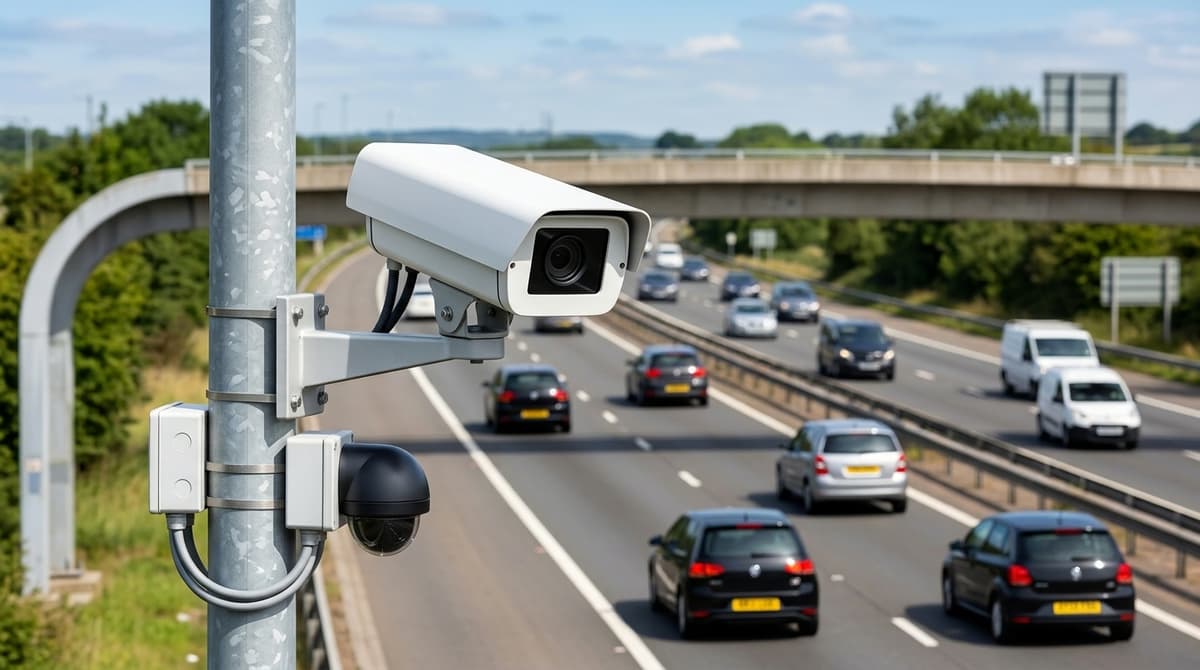
Fixed units are usually compact box or bullet-style cameras, often with a ring or bank of infrared lights around the lens or a separate illuminator beside it. They tend to be fixed to poles, gantries, walls or barrier posts and aimed along a lane at the plate rather than across a wide scene. Mobile units are fitted to vehicles or trailers. Signs warning that ANPR is in use are another way to spot a site.
Are ANPR cameras speed cameras?
No. An ANPR camera reads number plates, and a speed camera measures how fast a vehicle is travelling. They overlap in average-speed enforcement: Clearview notes that ANPR is used in a number of motorway cameras to work out average speed by comparing when the same plate is read at two points. ANPR can also record the plate of a vehicle caught breaking a rule so that it can be used for enforcement afterwards. Whether a particular camera does either depends on how it is set up.
How long is ANPR data kept, and who can see it?
It depends on the operator. For police ANPR, Clearview quotes the National ANPR Standards: read records must be deleted within 12 months of capture unless the law requires them to be kept, and most staff with permission can access them for a maximum of 90 days from collection. Private operators cannot search police ANPR databases, and they have to set and justify their own retention period under UK GDPR.
- anpr
- camera
- meaning
Written by
Clear Security Editorial Team
Buying guides researched against the equipment we stock, with every specification checked back to the manufacturer's datasheet and UK guidance reviewed before publication.
Related reading
- ANPR Camera Cost UK 2026: Hardware, Install and Systemsanpr camera cost uk
- ANPR Camera for Home UK: What It Reads and Costs (2026)anpr camera for home
- PTZ Camera Meaning: Pan Tilt Zoom CCTVptz camera meaning
- HD Over Coax Camera Systems: UK Guide for 2026hd over coax camera
- CCTV Lens Size for Face Recognition at 10 Metres (2026)what lens size cctv camera do i need to see a face at 10 metres
- CCTV Camera Cost for a Shop UK 2026: Full Guidecctv camera cost for shop