
cctv signage requirements uk
CCTV Signage Requirements UK: Checklist
If you run CCTV for a business, you must tell people they may be recorded, "usually by displaying signs" that are "clearly visible and readable", according to…
On this page
- Which signs must be displayed for CCTV under UK rules?
- Home CCTV
- Check the live ICO page
- Do home CCTV systems need signs?
- When the answer changes
- Practical steps (general guidance, not legal advice)
- What must a CCTV sign say?
- Audio
- The generic sticker problem
- Cheap CCTV signs
- Where should CCTV signs be placed?
- Shared and communal spaces
- Who fits it
- How big should a CCTV sign be, and how do you keep it compliant?
- Material and durability
- Maintenance checklist
- Handover record
- Related products
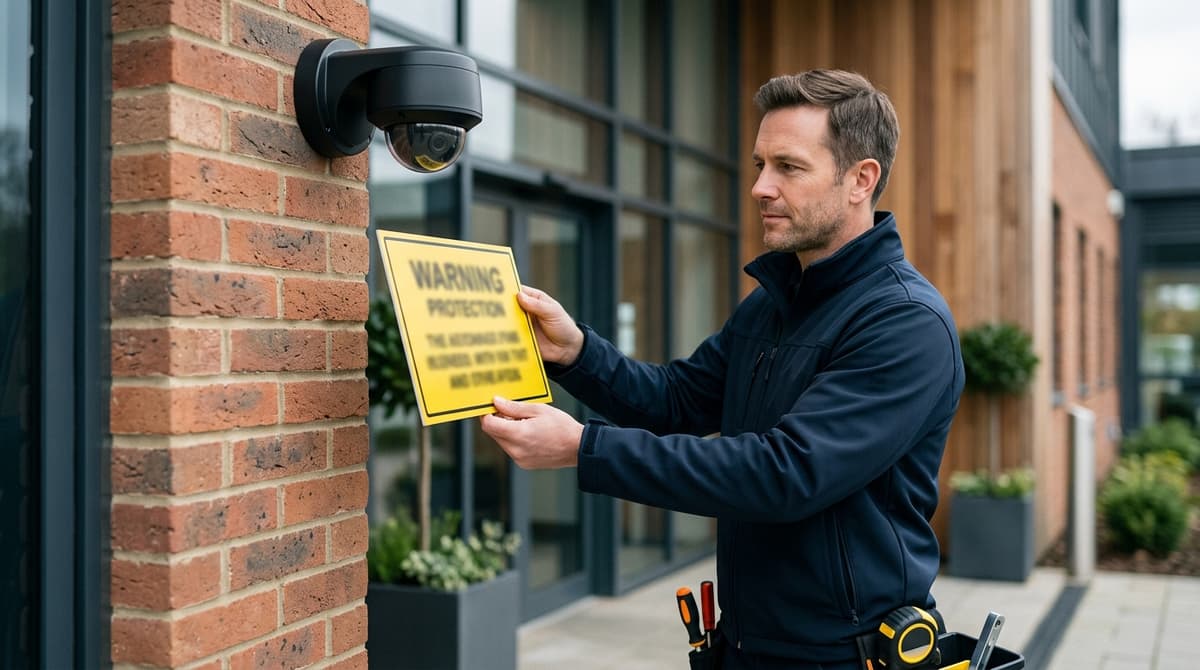
If you run CCTV for a business, you must tell people they may be recorded, "usually by displaying signs" that are "clearly visible and readable", according to GOV.UK. A purely household camera sits outside data protection rules, but that exemption ends once it captures a neighbour's property or a public area.
This guide covers what to put on a sign, where to place it, and why you should check the live ICO page, as its CCTV guidance is currently under review following the Data (Use and Access) Act.
Which signs must be displayed for CCTV under UK rules?
For a business, you must tell people they may be recorded, and GOV.UK says this is "usually by displaying signs" that are "clearly visible and readable". The duty is to inform people, and a visible sign is the usual way to do it. "Usually" is GOV.UK's own hedge, so don't read it as "always".
The legal basis is UK GDPR and the Data Protection Act 2018, with the ICO's CCTV guidance explaining how to apply them. Pages that still cite pre-2018 legislation are out of date.
Home CCTV
GOV.UK says data protection rules do not apply if you install a camera on your own home for household purposes, such as protecting it from burglary. The ICO's home CCTV guide covers fixed cameras and smart doorbells, and notes that owners still have some rules to follow. Read it before assuming nothing applies to your setup.
Check the live ICO page
The ICO's CCTV for your organisation page currently carries a notice that the guidance is under review following the Data (Use and Access) Act and may change. Check that page, rather than any copy of it, before you finalise signage for a new CCTV system planner.
Do home CCTV systems need signs?
No. A camera used purely for household purposes, such as protecting your home from burglary, does not carry a data-protection duty to display signs. GOV.UK says data protection rules do not apply to a camera installed on your own home for those purposes. That answers most domestic "is CCTV signage a legal requirement" questions, but only while the camera stays within that limit.
When the answer changes
The ICO's home CCTV guidance covers fixed cameras and smart doorbells. It says data protection law applies if your camera captures someone else's property, a public area or a communal space.
A doorbell that looks across a shared drive, or a camera that takes in the pavement, no longer sits comfortably within the household exemption. In that case, work from the ICO guidance rather than assuming you're exempt.
Practical steps (general guidance, not legal advice)
- Angle each camera so it covers only your own property.
- Use privacy masking to block neighbouring areas if the camera supports it. Confirm this on the product datasheet before you buy.
- If some spill-over remains, put up a clear sign anyway. It costs little and tells passers-by they may be recorded.
What must a CCTV sign say?
A CCTV sign must state that cameras are operating, who operates them, why footage is recorded and how to contact the operator. If cameras record sound, the sign must also say so.
A CCTV sign should state that cameras are operating, who operates them, why footage is recorded and how to contact that operator. The operator, purpose and contact elements follow the ICO's CCTV for your organisation guidance. That page is marked as under review following the Data (Use and Access) Act, so check its current wording before you print a batch of signs.
- CCTV is in operation: a plain statement, with or without a camera pictogram.
- Who operates it: the organisation responsible for the footage.
- Why it records: the actual purpose, such as crime prevention or safety.
- How to contact them: a phone number, email or postal address that someone will answer.
Audio
If any camera records sound, say so on the sign. This is general good practice rather than a rule cited here, but otherwise nobody walking past knows they are being listened to as well as watched.
The generic sticker problem
A bare "CCTV in operation" sticker with no operator or contact fails the checklist above. Anyone can ask to see images recorded of them, and GOV.UK says you usually must supply them free within 1 calendar month. If the sign never says who runs the system, people cannot tell whom to ask.
Cheap CCTV signs
Price is not the test for cheap CCTV signs. Check that the sign carries the content above, that the text is legible from where people will read it, and that the material will survive the weather where it is mounted. For a pub-specific view of these requirements, see CCTV policy for pubs under UK law.
Where should CCTV signs be placed?
Place signs at every approach to the monitored area, so people read them before they enter the camera's view, not beside the camera itself.
- Map each camera's field of view. Sketch the area it actually covers, not just where it is mounted.
- Sign each approach. Put a sign at every gate, door or path that leads into that area.
- Add signs where cameras are hard to spot. Car parks, rear yards and shared entrances are the usual gaps.
- Set signs at readable height. As general guidance, light or reflective signs help at night.
- Photograph each sign in position. Keep the photos with your records.
Sign location should follow what is monitored, not where the camera is mounted. A sticker tucked behind a reception desk fails the "clearly visible" test.
Shared and communal spaces
Where a landlord, tenants or a managing agent share an entrance, agree who operates the system. The sign should name that operator, as the ICO's guidance for organisations expects. The ICO notes this guidance is under review following the Data (Use and Access) Act.
Who fits it
Your own electrician or installer mounts the signs and cameras. Check each camera's datasheet or installation guide for its coverage before you fix anything to the wall.
How big should a CCTV sign be, and how do you keep it compliant?
Make the sign readable from where people will decide whether to enter the monitored area, using installer judgement rather than statutory size. Review signs when cameras change, check legibility regularly, keep ICO registration current and confirm cameras are used only for stated purposes.
The sources cited here set no statutory size or font, so make the sign readable by someone deciding whether to enter the monitored area. That is installer judgement, not a legal measurement. A sign that can only be read from a metre away is the wrong choice for a car park entrance, however neat it looks.
Material and durability
For outdoor positions, choose a weather-resistant sign and replace any that fade or get damaged. A bleached or cracked sign no longer does its job. Signs don't carry the kind of rating cameras do, so judge them by how they hold up in your location.
Maintenance checklist
- Review the signs whenever you add or move a camera, or when the system's purpose changes.
- Check legibility at intervals, from the position where a visitor would first see the sign.
- Keep your ICO registration and fee current. GOV.UK says you can register and pay online.
- Confirm the cameras are used only for the stated purpose. Monitoring staff productivity is the example GOV.UK gives of a use that falls outside a security purpose.
Handover record
Keep a short record of where each sign is, what it says and when you last checked it. The contents page of a published code of practice lists a customer handover and acceptance annex, which suggests formal handover paperwork is an established part of a CCTV job.
Related products
Related products from our own range:
- CCTV warning sticker — 24-hour CCTV warning sticker.Self-adhesive warning sticker stating that the premises are under 24-hour CCTV surveillance.
Recommended products
From our own range — picked for what this guide covers.
Frequently asked questions
Do security cameras have to have signs?
For a business, you must tell people they may be recorded, which GOV.UK says is "usually by displaying signs" that are "clearly visible and readable". The wording is "usually", not "always". Signs are the expected method, so skipping them needs a strong reason and another clear way of informing people.
Are CCTV signs compulsory at home?
A purely household camera sits outside data protection rules. That exemption ends once the camera captures a neighbour's property or a public area. At that point you should treat it like business CCTV and tell people they may be recorded, with clear, readable signage.
What signage do I need for CCTV?
You need signs that are clearly visible and readable, so anyone entering the monitored area knows they may be recorded. Check the ICO's live "CCTV for your organisation" page for current detail on what to include, because the ICO says its CCTV guidance is under review.
What are the regulations for CCTV in the UK?
CCTV is covered by UK GDPR and the Data Protection Act 2018, with ICO guidance explaining how they apply. Ignore pages that still cite the Data Protection Act 1998. The ICO notes its guidance is under review following the Data (Use and Access) Act, so check the live page.
Is a notice sticker required when you run CCTV?
The rules ask for signs that are clearly visible and readable, not a particular format. A sticker only works if people can see and read it before entering the camera's view. A tiny or faded one risks failing that test, so a proper sign is the safer choice.
Sources & references
- Cctv Signs
- CCTV Warning Signs: What You Need to Know – The Safety Sheep Store
- Do you need to display CCTV recording signs? - Lasting Impressions
- Data protection and your business: Using CCTV - GOV.UK
- CCTV for your organisation: things you need to do - ICO
- Surveillance Camera Code of Practice
- Home CCTV systems | ICO
- Surveillance Camera Code of Practice Pursuant to Section 29 of the Protection of Freedoms Act 2012
- cctv
- signage
- requirements
- uk
Written by
Clear Security Editorial Team
Buying guides researched against the equipment we stock, with every specification checked back to the manufacturer's datasheet and UK guidance reviewed before publication.
Related reading
- Home CCTV Systems UK 2026: Wired or Wireless?home cctv systems uk
- CCTV Christmas Shopping Season 2026: UK Readiness Guidecctv during christmas shopping season uk
- CCTV and UK GDPR: Rules for Buyers and Installersgdpr cctv rules uk
- CCTV Law UK: Compliance Guide for Home & Businesscctv law uk
- Best CCTV System 2026: How to Choose for UK Homes and Shopswhat cctv system is the best
- CCTV Lens Size for Face Recognition at 10 Metres (2026)what lens size cctv camera do i need to see a face at 10 metres